Security & tenancy
Tenant boundaries, restricted database roles, and audit records are built into the access path.
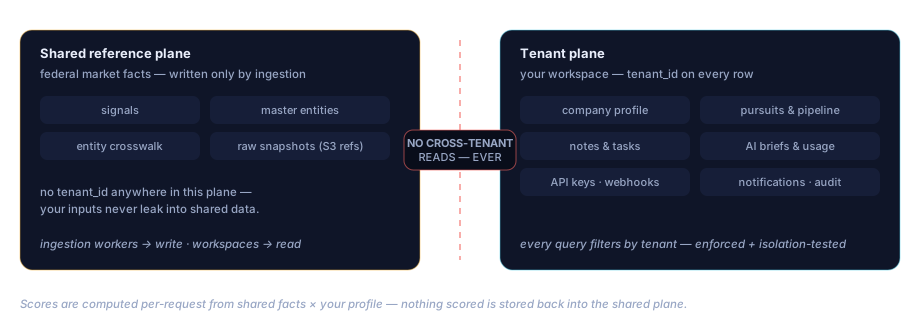
Verification status. Forced row-level security and restricted runtime roles pass local isolation checks. Their application and two-tenant exercise in staging, production verification, and independent acceptance remain open.
- Tenant isolation — tenant-owned tables use
tenant_id, forced row-level security, scoped database sessions, and isolation tests. - Two data planes — shared federal reference data and tenant data (profiles, pursuits, notes, keys) have separate write and access paths.
- Authoritative audit history — meaningful user, AI, workflow, integration, configuration, and security actions retain actor, timestamp, entity, reason, request context, and bounded before/after evidence in the owner/admin Audit Center.
- Credentials — API keys stored as SHA-256 hashes, shown once; webhook secrets per endpoint; cloud secrets live in a secrets manager, never in code.
- Report sharing — shared reports use 256-bit random bearer tokens with only SHA-256 digests stored, explicit expiry and download permission, immediate revocation, no workspace credential forwarding, and immutable tenant snapshots.
- Network — the database is not publicly reachable; webhook deliveries are SSRF-guarded; the public API is key-scoped and rate-limited.